Categories

Photo Gallery

World Campus International, Inc.
Dai 2 Ebisu Heights #101
4-17-8 Ebisu
Shibuya-ku, Tokyo
150-0013
Japan

Contact Us in Japanese:
+81 3 3473 1120
Fax: +81 3 5475 5842
hyasui@worldcampus.org

Contact Us in English:
+1 303 495-2078

Toll free USA / Canada:
+1 866 595-6323

Fax: +1 303 495-2069
rsloat@worldcampus.org

March 31st, 2008

On March 24th, the World Campus International participants had a lecture about Buddhism by a monk (who was also my host mother) and then took part in a series of presentations and discussions organized by the participants.

In the lecture given by Ms. Okazaki, she explained to us her view of Buddhism. Quite a few of the participants from western cultures were surprised that Buddhism should be considered a religion because they had heard Buddhists say it’s more a way of life than an organized religion back at home.

We learned that there are a lot of different forms of Buddhism and the one she is practicing is called Nembutsu Buddism which is based on the teachings of High Monk Shinran (1173-1262).

Shinran spread the teaching of the Nembutsu. The preaching of the absolute power of the other, that one need only trust entirely in Amida Buddha. He focused on the forty-eight vows of Amida and if we have faith in Amida, we have already been saved.

Taking the Nembutsu as an invocation of gratitude to the Buddha, he categorically denied practices of one’s own power as superfluous. He preached absolute reliance on power of the other (= Amida), such that one is saved when one achieves correct faith.

Afterwards we had presentations and discussions on other World Religions. Groups of 4 to 5 World Campus — Japan participants presented a certain religion to the others so that everyone had a basic understanding of those religions in order for us to talk about them. Those religions were Hinduism, Islam, Christianity, Judaism as well as Buddhism.

Whenever possible in our discussions we did give people in our group who belonged to one of the discussed religions also a platform to explain their views of their own faith.

We also asked people about the stereotypes of different religions and discussed that some religions had bad media representation and can be misrepresented.

In this process we learned a lot about religions and how people from different ones can work together on a topic like religion with out having negative outcomes as seen so often in the world.
In the end we also gave people who are Atheist time to speak so they could share their views too.

After the discussions, everyone agreed that no one should have a bad view of someone because they have different faiths and that we should live together and respect other people’s values and belief systems.

It was a great day to be able to discuss a topic which is not easy in such a kind and friendly manner with people from all around the world including the local Japanese and we all learned much and did get a step closer to understanding global citizenship.

I wish that all religious leaders in the world could experience that what we did here in Uda City in Japan in our discussion about World Religions as it would really change their world as well.

(Daniel Gallion, Luxembourg )
March 30th, 2008

March 29th was a day filled with song and dance. It began on a wonderful note with a “Share your skills” session among World Campus — Japan participants, which included a beautiful Ugandan song by Stephen. As with all music, knowledge of the language is not necessary to be able to understand the passion and beauty of the piece. Thank you Stephen!

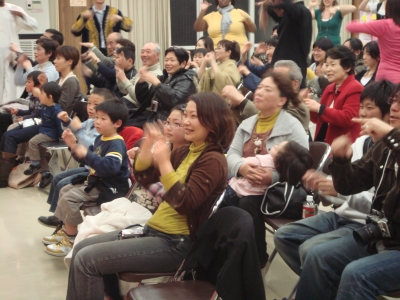
In the afternoon we had the privilege of participating in a concert in Uda city. The concert itself was headlined by Mr. Tomoya Takaishi. Truthfully, none of the participants had ever heard of Mr. Takaishi before, but he was once a popular protest song singers in the 60’s. Although he had retired from mass music business a few decades earlier to lead a quiet life, the cozy gymnasium was still packed to the brim with his adoring fans.

Mr. Takaishi was quite the entertainer, often encouraging the audience to sing and clap along to certain portions of his well-known classics. This tactic was rather useful in keeping World Campus — Japan participants alert.

The best part of the concert was certainly when the children’s choir from the local Music Village were on stage. Their performance was indescribably adorable, especially when they swayed in unison as they sang. かわいいですね! (How cute!)

Although it was his concert, Mr. Takaishi was kind enough to invite us up on stage to accompany him for a couple of songs, as he thought World Campus — Japan is the “Wind” to bring positive energy to the local community, while the community being the “Soil” for the changes to take place in.

A few verses of the always cheerful, “You are my sunshine” rejuvenated us. And our international group’s singing of the chorus of “Hana”, a traditional Japanese folk song, amazed the elderly crowd. Our contribution to the community event was rather small but enjoyable nevertheless. I was even able to fight through legions of rabid fans to snag an autograph!

(Guang Yeung, United States of America, Colorado)

March 26th, 2008

Our trip from Uda to Nara started with a 1.5 hour train ride in which we changed trains twice and luckily didn’t loose anyone in the group. We were guided by members of the Local Organizing Committee of Uda along with two volunteer tour guides who were happy to share information and stories along the way.

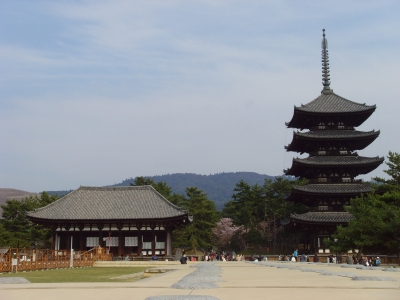
In Nara, we were welcomed by the unusual sight of tame deers who were quite friendly and were waiting to be fed in exchange for a Japanese style bow! Afterwards we saw a variety of Buddhist temples that are registered on the UNESCO world heritage list. The highlight for me was the Todaiji temple, which is one of the oldest wooden buildings in the world, containing an antique sitting Buddha statue – which raised the question - How did people constructed this piece of art back in 752 AD?

Our guides helped us to understand the basics of Buddhism and the way people integrate this religion into their daily life. I found it difficult to really understand - especially in comparison to other religions - but everything I heard made me curious to learn more.

Afterwards we had the chance to visit a Shinto-shrine surrounded by thousands of stone lanterns and hear about and see the rituals and rules of Japanese people practicing this belief. What really impressed me was that in the shrine area you would never cut a tree as every living being is worshiped in its own way - that’s why you could see an old tree integrated into buildings instead of being removed for the construction of man-made structures.

Sitting in the train on the way back, I was still impressed and curious to find out more about these two religions, coexisting and so well integrated into the every day lives of most of my Japanese host families.

(Ute Weber, Germany)

March 22nd, 2008

This is the Slideshow of our time in Suita City during our Feb. 2008 Tour!

March 21st, 2008

The city theme for Suita was globalization and I found it to be particularly interesting because it connected with WCI’s main mission of creating global citizens. Suita city itself is very urban and the participants were excited to explore what the city had to offer.

Upon our arrival in Suita city, we were welcomed by the city mayor, Mr. Yoshio Sakaguchi. He brought warm regards on behalf of the citizens and welcomed us to the city during an exciting time of year as the World Expo memorial events were taking place during our visit.

Early in the week we were able to visit two companies. One group of participants visited an egg company while the other group visited a noodle company. Both groups had unique experiences interacting with the staff members in each company. This was an exciting opportunity for both participants and the company staff as we introduced our theme of globalization. We were able to exchange ideas with management and staff on various topics relating to globalization and its effects on businesses across the world, for example, economics and global warming.

We also had another unique opportunity to visit the Asahi beer company. We were able to tour the company observing that the company was very effective with waste management, recycling nearly 100% of all the products they use to manufacture their product. It was also a great opportunity for the participants to inquire as to how Asahi is currently handling the issue of globalization. This experience was meaningful because it was held after our internal group discussion about globalization where members shared their thoughts about developed countries opening up for developing countries in order to have a share in globalization.

Additionally we spent another day visiting two very different companies in the city; the Mitsubosh Diamond Company and Asahi Broadcasting Company. The diamond company expanded our view as we observed their practical approach to building networks across the globe. We had a lot of interaction with the employees there and that helped us to further understand how companies in Japan approached globalization. For added experience, participants were able to use public transportation for the first time on the tour as a means of understanding how transportation systems work compared to those in their home countries.

Our participants grew a lot from the interactions that they had with the companies as well as host families in our globalization-focused stay in Suita city, Osaka.

(Henry Musenze-Mukasa, Uganda)

March 19th, 2008

Suita ExpoOn Sunday, March 16th, World Campus — Japan Participants were invited to attend the Suita Expo Event and to present our group’s mission of intercultural exchange. Of course, we brought some of our clothes and goods from our home countries to display as well. Beside the booth we performed a Japanese Medley on stage and some of us were interviewed by a famous radio DJ. In addition, four of us got the chance to take part at the 1.5 km family marathon.

The day started with a surprise for the team who had properly arranged all the goods and clothes from the different countries the day before, including hanging the appropriate flags behind the tables against the walls. But when we arrived on Sunday, we were told to rearrange everything in another booth which, luckily, was nearby. Soon after we finished the setup, the first visitors arrived and we got the chance to explain the displayed goods and the culture or history behind them.

Shortly after lunch, the first highlight of the day was on schedule; the 1.5 km family marathon where four of us, Guang from the U.S., Henning from Norway, Henry from Uganda and myself, were invited to take part. Because we were lined up at the very end of the participants at the start, we had to find our way through all the kids and family members to catch up to the front. As a former semi professional sportsman I am not able to take part at a race without going for the top. Despite the fact that I had not really practiced anything during the past four years, I almost caught up with the leader and finally finished in second place which was a big surprise even for myself!

The Marathon Team

Not long after the race, around 3 p.m., we attended a performance of a local dance and music group and were asked to come on stage and try to take part in their show. The audience in front of the stage was quite impressive and included many enthusiastic people of our own age. Soon after the dance and music performance finished, a well known local radio DJ came on stage and to interview some of us.We changed to another stage after the interview where we performed some parts of our Arigato Event performance, including country introductions and the Japanese medley in front of a less numerous, but more serious, audience.

Over all, the Expo Event was a superb platform to present World Campus International and it’s many different facets. It gave us the chance to get in touch with a lot of people we would not have met elsewhere. Thank you Suita!

(Cyrill Gross, Switzerland)

March 18th, 2008

In Suita city, Osaka Prefecture, the World Campus - Japan class had the opportunity to visit several companies that are located in this area. Below are reports from 2 of our participants.

Company Visit
1. The Malony Co., Ltd.

I visited Malony Co., Ltd. on the March 17th. The company is known for producing the famous Malony (noodles made of corn and potato starch), which you can find in most supermarkets throughout the country. Production of these started in 1964 and they sell especially well during the wintertime, when used by most Japanese in Nabe (Japanese kind of Hot Pot).

We got to talk to the general manager of the sales division of the company, got an overview of the company’s development and had the chance to ask questions. Another fascinating part was when we got to see the different stages of how noodles look like while being produced. First it looks like a thick, clear and soft sheet of gummy. This is then cut into long noodle strains of about 2.5 meters, before the noodles are cut into their original size.

It’s been a fun and informative day. We all had to wear white protective clothes and a hat because of hygiene reasons, which made all of us look like smart chemists. I had the chance to take home a couple of long noodle strains to proudly show to others.

We learned that the company does not really expand to the international market for the time being. It would be very hard to compete against the local market in a different country, since the success of a food company is especially depending on dietary needs in the region.

(Sophia Potter, Germany)

2. The Asahi Broadcasting Company

I went to the Asahi Broadcasting Company (ABC). ABC is a local television and radio station, which primarily produces TV programs and radio for the Kansai Area for approximately 21 million people.

Our tour began with a round table discussion where our initial questions were answered. We learned that Japan has 7 key stations throughout the country plus many local broadcasting companies.

While visiting the master room, where the TV shows are brought on air, one could already see the change from analog to digital TV. In fact, ABC will move to a new building this year because they will be getting new equipment for this rapidly growing digital age. Another very interesting opportunity was to watch an on air radio interview, because you could see the radio moderator live in action.

After the lunch at the company cafeteria, we went to see the ABC symphony hall, which was the first concert hall exclusively built for western classic music in Japan. Not only the sound quality but also the huge pipe organ was astonishing.

(Katharina Haack, Germany)

March 17th, 2008

This slideshow was created by our World Campus — Japan Participant Henning from Noway during our stay in Arao city for our Feb 2008 tour!

March 16th, 2008

Not only can the word revitalization be rather difficult to pronounce, the term is often equally as tough to explain. In the city of Arao, the World Campus — Japan participants were able to learn first-hand through daily activities at the cultural center including guest speakers such as Mayor of Arao, Mr. Junji Maehata, and his chief of revitalization, Mr. Junji Maezono, visits to Saiyoji Temple, Manda Coal mine and Shodai arts + crafts center.

As a method of looking closer at revitalization as a theme, WCI participants took one day to participate and learn from business owners and leaders in the community. According to the Mayor’s office, from an economic standpoint the businesses in the neighborhood represent such a large part of the cities motivation behind attempting to revitalize the community. Participants were divided into groups and worked along side owners in small restaurants and herb gardens, as well as a small winery. The day proved to be very effective and participants and business owners learned a lot from the cultural exchanges they shared.

Over the years, the city of Arao has gone from being a huge source of resource to merely a town known for its unique coal mine history. Revitalization has become so important due to the change in universal energy source from coal to petroleum. The well-known coal-mine, which once not only provided energy to the town, also provided employment to many Arao citizens. Once the coal mine closed, citizens and their families moved to near by towns to find work and a new life.

As a native Chicagoan, I was exceptionally interested in revitalization as a theme. As Chicago moves toward the next Olympic bid, I am constantly surprised at the amount of revitalizing our local government does in order to gain the nomination. Although revitalization speaks of changing from a local perspective, it is a theme used globally in communities worldwide.

Our participants which currently in this session represent over 10 countries and 5 continents shared similar sentiments about their communities. It seems as though globalization is a main factor for communities around the world attempting to revitalize or renew their communities peeking the interest of other and renew the pride in current citizens.

(Faith L. Walls, the United States of America)

March 15th, 2008

Gent

After a three week visit to Europe which brought Bob Sloat to Switzerland, Germany, Luxembourg, Belgium, the Netherlands and Denmark, we would like to extend a heartfelt appreciation to the WCI alumni, friends, supporters and upcoming participants who welcomed Bob along the way for presentations and meetings regarding the World Campus — Japan program.

In addition, a special thank you goes out to the following institutions:

  • Switzerland: St. Gallen University, the University of Zürich, Volkshochschule Beider Basel, HWZ Hochschule für Wirtschaft Zürich and the Swiss – Japanese Society
  • Germany: Schule Schloss Salem
  • Luxembourg: Université du Luxembourg
  • Belgium: Universiteit Gent
  • The Netherlands: The Tanuki Organization at the University of Leiden as well as the AIESEC student organization in Nijmegen
  • Denmark: The Copenhagen Business School, the University of Copenhagen and the University of Roskilde
Next Page »

Language

English is on.

Archives

Search Form

Links

Meta

Recent Comments

Powered
by FeedBurner

Add to Google Reader or Homepage

Subscribe in NewsGator Online

Add World Campus International Blog to Newsburst from CNET News.com

Add to My AOL

Add to netvibes

Subscribe in Bloglines

Add to The Free Dictionary

Add to Plusmo

Subscribe in NewsAlloy

Add to Excite MIX

Add to flurry

Add to Webwag

Add to Attensa